
monk echo
reverb and delay
both beautiful and strange
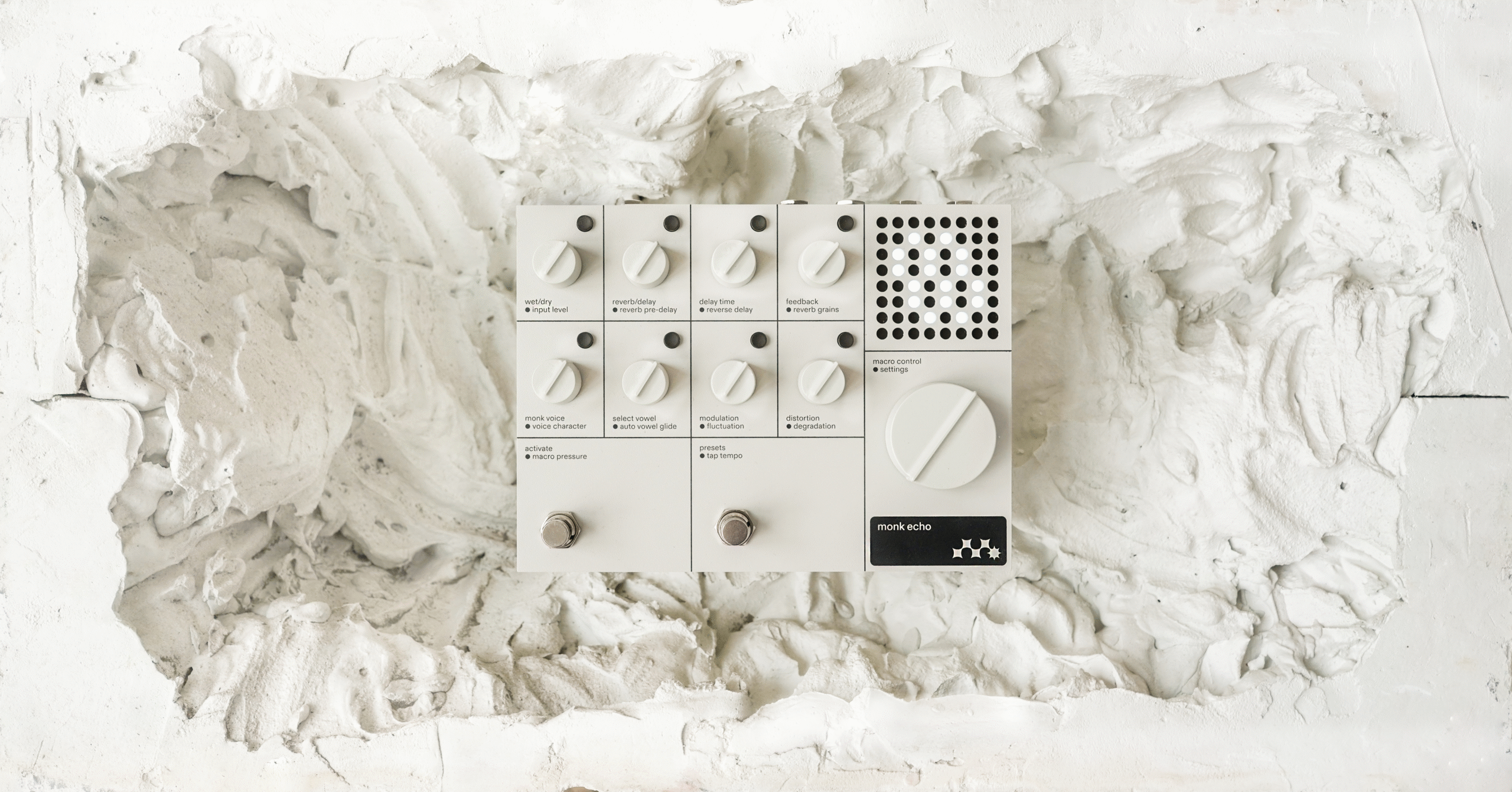
Your echo has a voice now.
Monk echo infuses your sound with the character of the human voice and lets you morph entire soundscapes with a single, effortless gesture.
It’s a sound-design tool disguised as a guitar pedal. Monk Echo brings together reverb, delay, the monk-voice engine, responsive modulation, granular pitch-shifting, distortion, and a unique degradation effect. All of it can be controlled through the pedal’s unique macro control knob turning this pedal into a performance instrument.
For explorers and casual tweakers, for late-night bloomers. Step into monk mode – where sound becomes your navigator and you drift someplace. From lovely to ugly, from broken to golden, and everything in between. This will take you there.
monk echo is currently sold out
Thank you!
a grand duet of reverb & delay
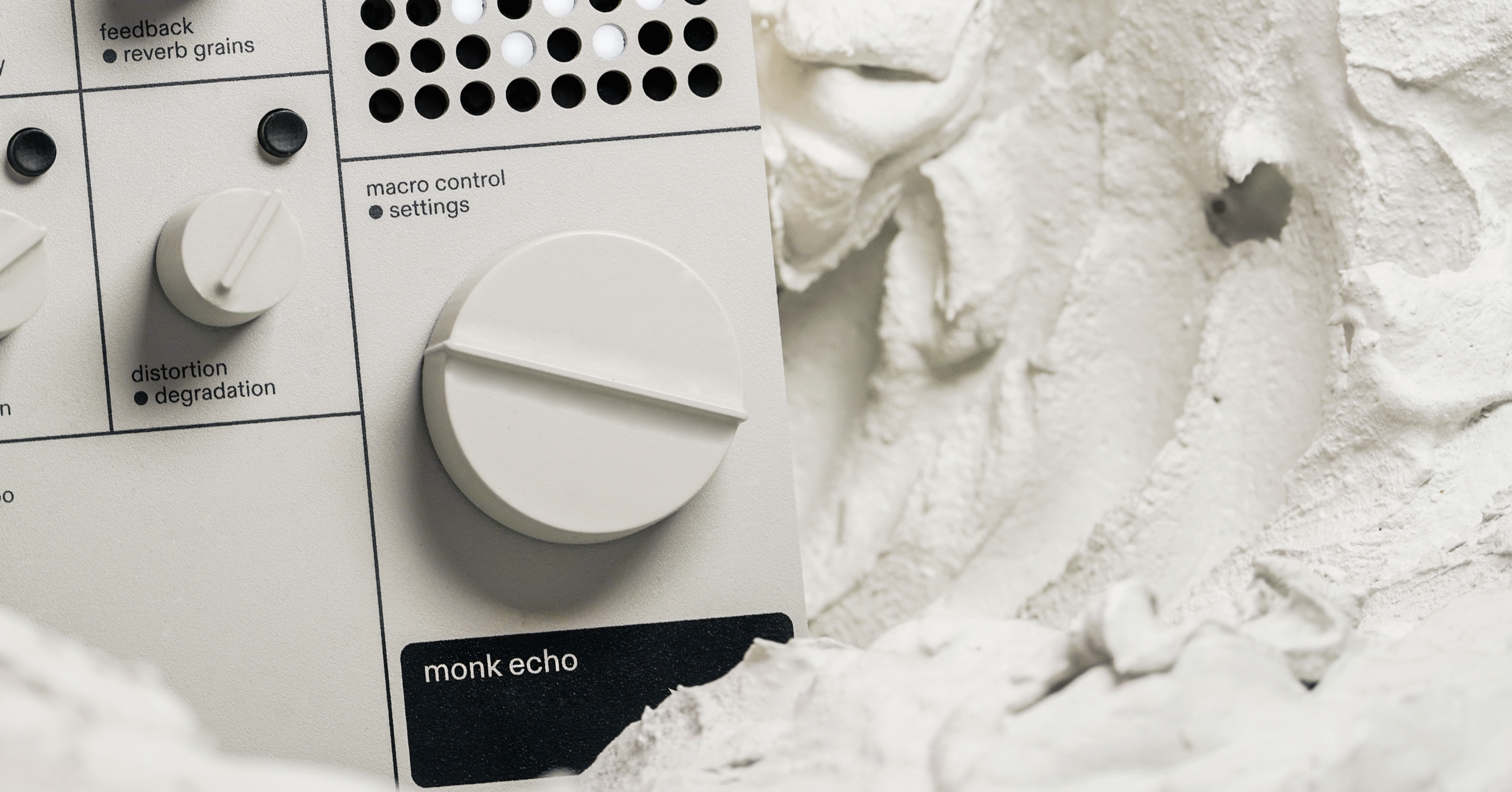
At its core, Monk Echo is a duet of a blooming, luscious reverb and a precise delay.
The reverb and delay are mixed and fed back to each other to create layers of evolving ambient echoes. With the mix knob, you can explore a full spectrum of textures. From endless reverb with only a whisper of delay, to bold rhythmic repeats with distant reverberations in the background.
The echoes can sustain indefinitely without collapsing into noise. But turn the feedback knob all the way up, and you’ll find yourself facing a self-oscillating wall of sound.
The silky smooth diffusion of the reverb combined with delay times ranging from 1 millisecond to 10 seconds acts as a basic building block for everything that monk echo does. Yet on its own, it works beautifully as your all-purpose reverb and delay combo.
monk voices

Inspired by Baltic choirs and mystical spaces, Monk Echo speaks in vowels.
The reverb and delay signals are shaped by morphing formant filters tuned to the resonant frequencies of the human voice. Add just a hint of this resonance for a distant resemblance to the human voice or push it to fully infuse your echoes with ringing vowels. Suddenly, it is like a choir of monks echoing through stone walls, joined by ethereal female voices and bright children’s tones.
Choose the vowel that monk echo sings in. Find the one that fits your song and your mood. Glide smoothly between vowels or let the pedal follow your performance and switch vowels automatically – in response to your playing dynamics and phrasing.
sound design tools
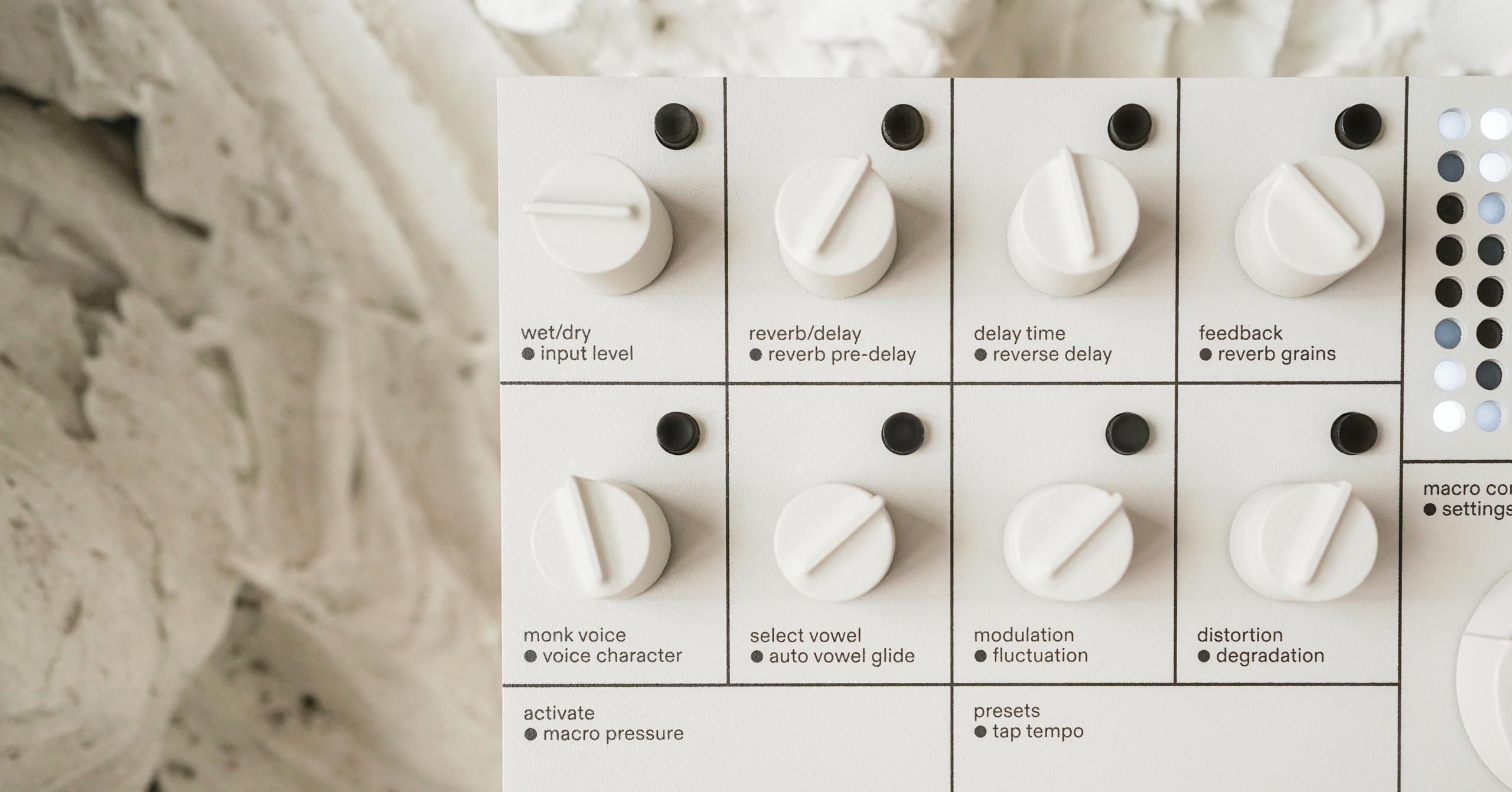
There are no algorithms, no pre-defined sounds – but eight carefully tuned sound design tools instead.
Each of the eight knob and button combos is simple on its own, yet reveals its full power when they interact. There is a ton for you to explore beyond the names of the knobs.
What we’re saying is that you can easily dial in your warm, saturated and modulated tape delay. It is easy. You don’t need an algorithm for that. With a few quick adjustments, you’re exploring shimmer reverbs, adding dreamwave degradation to your sounds that goes from vinyl crackle to complete disintegration. Morph into heavily distorted wah-wah solo (yes, on an echo pedal!). But why stop there? Turn a knob, press a button, and discover a sound that doesn’t even have a name yet. You’re in control. Explore it all.
these are your tools
continuously adjustable balance between reverb and delay
from metallic overtones at 1 millisecond to 10 seconds of pristine repeats that respond to tap tempo and midi clock
controls both reverb decay and delay repeats — from early reflections and a single repeat to endless self-oscillation that can remain stable or collapse into noise
instantly reverses delay playback without disrupting the sound
optional reverb pre-delay that is relative to the delay tempo — adds distance to reflections or introduces expressive, wobbly instability
granular pitch shifting ranging from shimmery audio-rate textures to rhythmical, softly swaying motion
adjusts how much of the monk voice blends into the echoes — from subtle vocal character to sharp resonances that can reach wah-wah territory
continuously shifts the voice character from deep male formants to airy female tones and bright children’s resonances
manual vowel selection or automatic vowel shifts reacting to your playing dynamics with adjustable glide from robotic jumps to smooth transitions
classic modulation that breathes life into delay repeats and adds depth to reverb tails
dynamic modulation – bends and reshapes echoes in response to your playing
grimy clipping of echoes ranging from gentle saturation to harsh noise
progressive decay of sound – from vinyl crackle artifacts to loss of nearly all sound with only sparse audio fragments left behind
continuously adjustable stereo width – from a focused sound in the center to wide ping-pong
low- and high-pass filters for shaping the tone of echoes – from deep lows and crisp highs to calm mid-focused warmth
Sounds




macro control
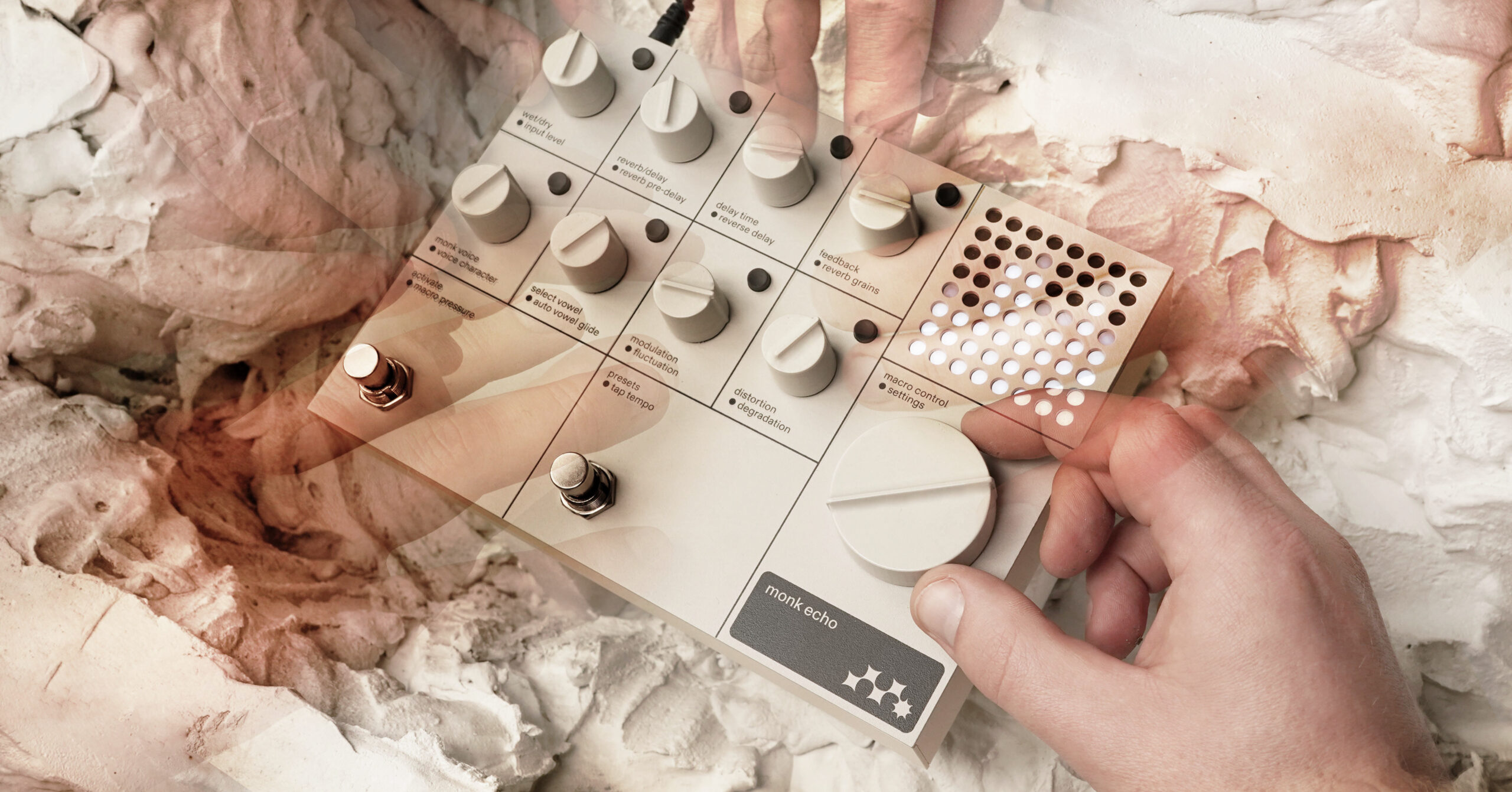
Step into the role of a choirmaster.
With the macro control you don’t need eight hands. You can reshape all sound parameters with a single gesture.
The large macro control knob lets you take full advantage of the powerful effect parameter knobs. Alter multiple or even all parameters at once with a single turn of the knob. Each parameter can move independently. For example, increase feedback and distortion while lowering volume and modulation. Morph the sound of monk echo from subtle to extreme in an instant and explore the unexpected sounds in between.
What the macro control does exactly is up to you – from subtle utility uses to extreme parameter jumps. The setup is fast and simple. When you find something worth keeping, save it as a preset. so you’re not just recalling a sound — you’re recalling how you perform it.
On stage, the macro pressure footswitch replaces the macro control knob for hands-free sound morphing. Furthermore, the rear-panel macro expression input lets you connect the expression pedal of your choice. Prefer MIDI? A single incoming CC can reshape all your parameters – fully programmable right on the pedal.
features list
grand reverb
1 millisecond to 10 second delay
monk voice vowels
manual or automatic responsive vowel selection
male, female and children voice characters
infinite reverb decay and delay repeats
granular reverb pitch shifting
reverse delay
static or responsive modulation
distortion – from mild to brutal
degradation – musical artefacts and signal dropouts
reverb pre-delay
macro control over all knobs at once
pressure sensitive footswitch
tap tempo
variable delay stereo width
master low and high frequency filters
stereo signal path
expression pedal input assignable to any single and multiple knobs at once
control voltage response via expression input
8 presets onboard, 127 presets in total via midi
full midi control, midi in, midi out and thru
classic pedal power or usb-c power inlet
straight forward front panel controls
advanced system settings for any possible setup scenario
front panel
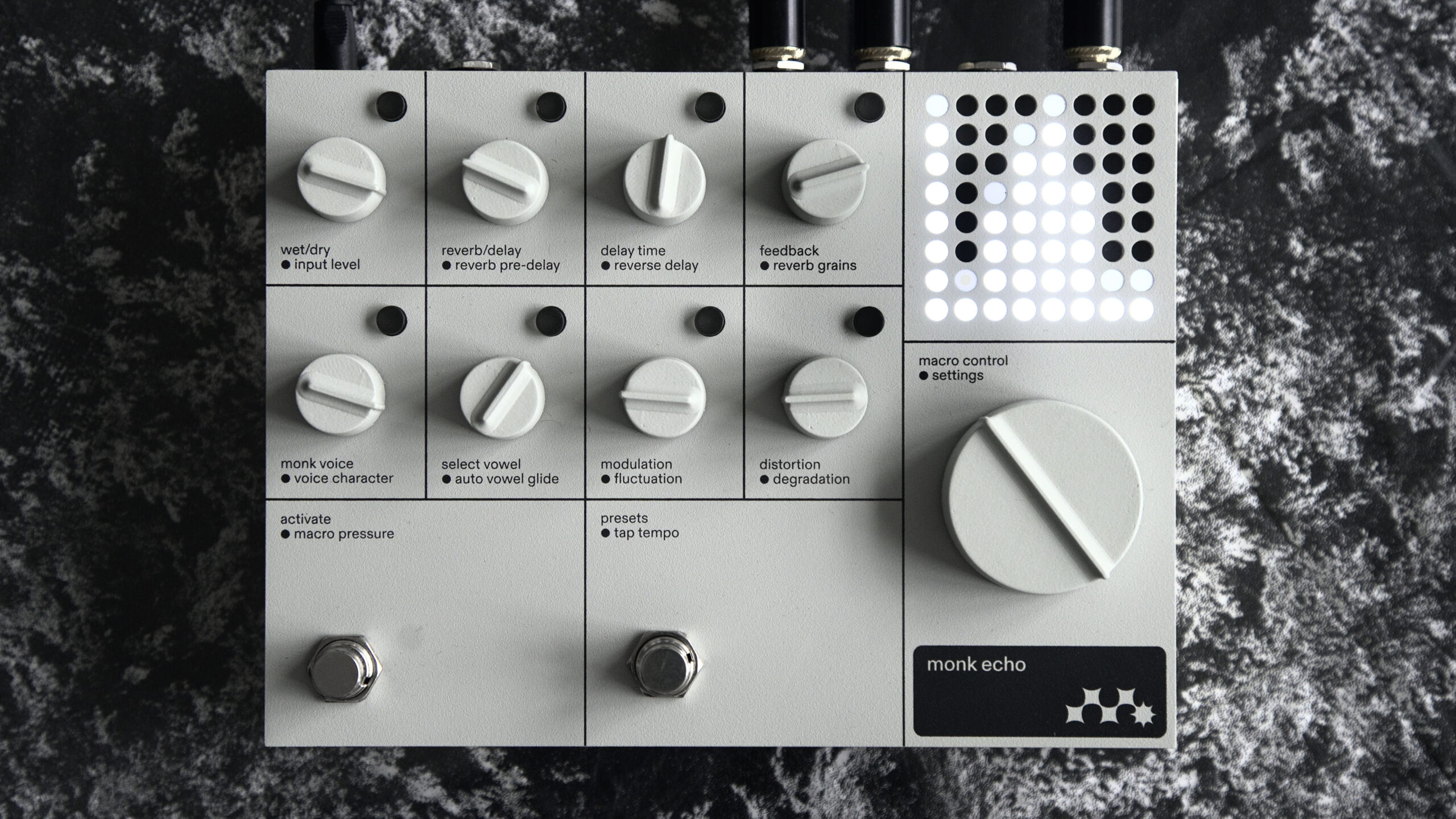
wet/dry
● input level
Control the mix between the dry input and the monk echo. The behavior depends on the state of the button in the upper corner of this window.
With the button off, the knob functions as a traditional dry and wet mix control.
With the button on, the knob adjusts only how much input signal is fed into the effect. The effect output with lingering echo tails remains at full volume at all times.
A simple utility on paper, but when linked to the macro control, it becomes highly expressive.
reverb/delay
● reverb pre-delay
Adjust the balance between reverb and delay.
Start out with immersive reverb and only a touch of rhythmic delay taps. Turning the knob to the other extreme produces clear, articulated delays with faint reverb. The center position creates a dense mixture of equal parts reverb and delay.
Pressing the button introduces reverb pre-delay to create a sense of spatial distance between you and the reflections. The pre-delay time remains rhythmically linked to the delay time knob.
delay time
● reverse delay
The delay time ranges from 1 millisecond to 10 seconds. From metallic ring-mod textures to forgetting you had a delay.
Engage the button to instantly reverse the delay. Back to normal. Reverse it again. Back and forth. With your finger on the button. Or your foot on the switch.
We nominate 2 millisecond reverse delay as your new favourite weird distortion.
The knob response is carefully tuned, so you don’t get lost in the 9.999 seconds of delay time range.
feedback
● reverb grains
This knob controls both reverb decay and delay repeats.
Start low for short early reflections and a single delay repeat. Turn it up to reach lush echo tails. Around 4 o’clock, you’ll discover the sweet spot where both reverb and delay sustain infinitely without collapsing into noise. But keep turning the knob and throw all precautions to the wind. Let the self-oscillating feedback take over. A loud noise warning is warranted.
The button activates granular reverb processing that ranges from audio-rate textures to slow, pitch-shifted modulation. The reverb tail is sliced into rhythmical grains that jump between octave and perfect fifth intervals. The grain size (or rate) remains rhythmically linked to the delay time knob.
monk voice
● voice character
This is the control that gives monk its voice. It determines how much reverb and delay pass through the monk formant filters. All the way up and you’ll hear only the strange monk resonances. Dial it back to blend them with clean and lush echoes.
Press the button to shift to voice character mode — from deep, moody male tones to ethereal female timbres or bright child-like resonances. A single twist changes the emotional color of your entire soundscape.
select vowel
● auto vowel glide
Two ways how the monk echo can accompany you.
With the button off, you are in control. Explore different vowels and find the one that feels good.
By pressing the button you let monk echo take over. Focus on your playing dynamics and once monk echo detects a volume accent it will choose a different vowel. By turning the knob you can determine how quickly one vowel will glide into another. From quick robotic jumps to smooth human-like transitions.
modulation
● fluctuation
Add movement. From slight chorusing to sickening instability. Both modes control the reverb and delay modulation but in two different ways.
With the button off you get a classic static sinewave modulation and the knob lets you dial in the modulation depth to your taste. Nothing wrong with good old classic modulation.
But when you turn the button on, the movement in both reverb and delay follows your playing dynamics. Play a note and the sound fluctuates for a moment and then returns to stability as your note decays. Play a louder note and it fluctuates even more. Crank the knob, stab a heavy chord and both the reverb and delay will wobble and bend under the pressure.
distortion
● degradation
By now you should have created big and lush monk echos. Now it is time to make them ugly.
With the button off, you are distorting the once beautiful reverb and delay tails. At first, it is a very slight distortion, reminiscent of an old radio with a weak speaker. But keep turning the knob and you’ll eventually get to a massive wall of overblown sound. Yes, it dooms.
Press the button and explore a more subtle side of ugly. If distortion adds to the sound, then degradation removes it. It removes a few bits of sound here and there. Like a vinyl crackle that sometimes pleasantly disrupts the music. Increasing the degradation will make the monk echo loose even more bits of itself, inevitably ending up with only a few short fragments of what it used to be – like a disintegrating mind.
activate
● macro pressure
The main footswitch activates monk echo. It uses a high-quality buffered bypass, preserving your tone and allowing reverb and delay tails to continue even when the pedal is bypassed.
Pressing the switch longer and applying pressure allows you to perform the macro control with your foot. This makes all parameter knob and button automation accessible on stage while your hands stay busy playing your instrument.
presets
● tap tempo
The secondary footswitch toggles between preset and tap tempo modes with a long press.
In preset mode, you can scroll through and recall the 8 onboard presets, or save new sounds to any slot using the footswitch together with the 8 buttons, which also serve as preset indicators. In total, 100 presets are accessible via midi.
In tap tempo mode, the footswitch temporarily overrides the delay time knob for rhythmic tapping. After setting the tempo, the delay time knob can still be adjusted gradually — it always remains unquantized. Tap tempo subdivisions can be accessed by pressing the macro control knob and are saved with each preset, giving you both quantized and unquantized delay options at all times.
dot display
The dot display provides clear visual feedback for all parameters and how the macro control interacts with them. Setting up and performing with the macro control becomes intuitive thanks to the gently dancing lights that mirror every change.
It also indicates bypass status, tap tempo, incoming midi messages, and guides you through the settings menu.
The display brightness is fully adjustable, ensuring comfortable visibility in any environment — from bright stage lights to a dark home studio late at night.
macro control
The macro control lets you adjust several or all parameters at once – smoothly and with precision. Think of it like a DJ turntable – with a single gesture you can alter the whole sound.
You can use it as a simple utility (for example, increasing feedback while lowering volume to compensate) or as an expressive sound exploration tool.
Setting up macro control is easy:
- Press and hold the button for the knob you want to link.
- Turn the macro control clockwise to increase the parameter and anti-clockwise to decrease it. Turn as far as you want the parameter to move.
- Release the button – the setup is done. Repeat for other desired parameters.
Now turning the macro control knob will move all linked parameters at the same time each following the direction and range you’ve defined.
Press the knob to access secondary sound shaping parameters – low frequencies, high frequencies, and delay stereo width. And hidden behind a long press is a comprehensive yet simple system menu including, bypass modes, MIDI setup and other utilities for integrating monk echo in your setup.
mentha works
monk echo is designed and manufactured in Latvia.
It is housed in a heavy-duty steel enclosure, finished in two-tone powder coating with a light sand texture. The front panel features a high-durability screen print and custom mentha works potentiometer knobs.
back panel
audio inputs & outputs
Stereo, mono-to-stereo or mono signal processing. Works with both instrument and line level signals.
Monk echo delivers a wide, immersive stereo reverb and delay with fully adjustable stereo panning.
MIDI
monk echo features fully integrated midi functionality
Program change messages can switch and save all 100 presets — far beyond what’s accessible from the front panel. Continuous controllers can adjust all parameter knobs and button states. More importantly, a single continuous controller can remotely perform the macro control while you set up parameter automation directly on the pedal, rather than on an external midi controller.
Delay time, reverb pre-delay, and reverb grain size all respond to midi clock.
The pedal also outputs a continuous controller when turning the macro control, allowing you to use this large, expressive knob to control other gear alongside monk echo.
macro expression
The expression input accepts either a classic passive expression pedal or an active control voltage to remotely access the macro control. This lets you adjust multiple parameters simultaneously — and even change button states — using a single expression pedal or control voltage from a synthesizer.
USB & power
The pedal requires a standard 9V pedal power supply with center-negative polarity and at least 300 mA. Alternatively, monk echo can be powered via the 5V usb-c port.
The usb-c port also serves as a connection point for future firmware updates and service, if needed.
specifications
187 x 142 x 59 mm / 7 3⁄8 × 5 5⁄8 × 2 5⁄16 inch
1.1 kg / 2.4 lbs
monk echo, rubber feet, mentha works zine, mentha works stickers
*the power supply is not included.
standard 9V power supply, center-negative, 300 mA or 5V usb-c power supply
subscribe to newsletter
Thank you!
join the workshop
If you want to follow the progress step by step, and see behind the scenes of the monk echo development, join our Patreon for free!